It’s Everyone’s Problem: Why Climate Change is So Much Worse Than You Think
By Yee Ning Yap, 2025-2026 Student Executive Committee Co-President
May 24th, 2026
You’ve noticed the increasingly hot summers, the increasingly warm winters coupled with brutal winter storms, and the increasingly random cold fronts. Perhaps you haven’t thought much about it, but maybe it’s time to start wondering why. In a world where each headline seems crazier than the last, it’s easy to overlook one of the most pressing issues of our time: climate change; in fact, less than 1% of global total news covers climate change. Well, if such a small portion of the news deems climate change a topic worthy of discussion, there must be more urgent matters to dedicate attention to, right? In this blog, my friends, I’ll explain why climate change is as urgent as it gets and why we should try to do something about it.
Let’s start by addressing the elephant in the room: climate change is not a myth. Climate change is not a conspiracy theory. Climate change, at least at its current rate, is not a natural part of our planet’s evolution. These claims stem from campaigns by oil companies like Shell and Exxon to generate doubt about climate change and mislead the public on its effects. Despite being aware of the relationship between burning fossil fuels and climate change, these companies spent millions of dollars on undermining the credibility of the scientific community’s research on climate science, effectively stalling climate action and preventing government regulation of the fossil fuel industry. It’s not just the fossil fuel industry, either. Fast fashion, automobile, and big tech companies have also launched campaigns of their own to downplay their industry’s effect on climate change through greenwashing, plant climate deniers in office, and pollute the digital landscape with climate misinformation. After all, why allow your contributions to climate change to be acknowledged when you could lose billions in revenue? For some, profit is a higher priority than the well-being of the only habitable planet in our solar system.
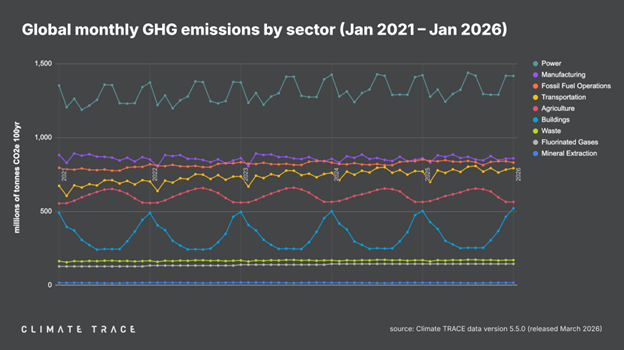
Source: Climate Trace
How climate change affects us
By 2030, cities such as Amsterdam, Venice, New Orleans, and Shanghai could be almost completely flooded due to rising sea levels. By 2050, large parts of London, Tokyo, and Bangkok will join them. Collectively, these cities are home to tens of millions of people and are major centers of trade, tourism, and cultural output. If – no, when these cities become submerged, their populations will be forced to migrate inland, billions of dollars worth of infrastructure will be lost, and historical landmarks will fall into ruin.
Not only that, but climate change causes extreme weather patterns and increases the frequency and intensity of natural disasters. As more greenhouse gases are trapped in the atmosphere, the planet’s air and oceans are warmed, disrupting the water cycle and natural wind patterns. This leads to worsened droughts, heat waves, hurricanes, wildfires, winter storms, and heavier precipitation in tropical areas. In other words, climate change serves to escalate existing weather patterns in certain regions, as seen with the 2021 Texas Snowpocalypse and 2025 LA wildfires.
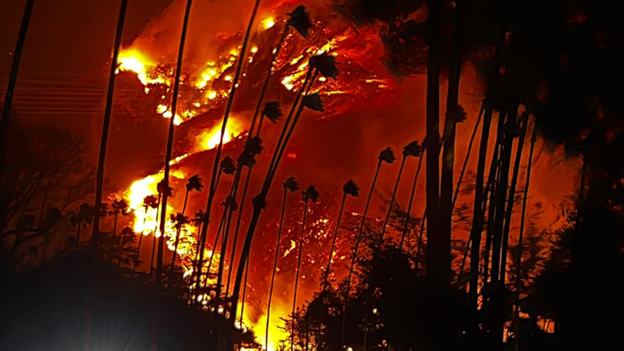
Source: BBC News
Additionally, climate change contributes to food scarcity. Rising temperatures and extreme weather patterns cause crop failures, especially for wheat, maize, and rice. Soil quality declines, with increased carbon dioxide in the atmosphere reducing the amount of essential minerals like iron, zinc, and protein. Warmer oceans threaten fisheries and aquaculture, as marine life cannot adapt quickly enough to rising temperatures. As global food supplies become limited, prices increase, forcing people to spend more of their income on food and leaving those near or below the poverty line unable to access their basic nutritional needs. Food scarcity is further driven by water insecurity, which is only aggravated by climate change. Worsened droughts reduce freshwater supplies, floods contaminate freshwater supplies, and rising sea levels mix freshwater with saltwater, making freshwater supplies unsuitable for daily use. The United Nations has already declared the world to be in a state of “water bankruptcy”, meaning that we will never be able to fully recover our freshwater resources. As an example, Corpus Christi, Texas, home to over 300,000 people, is in a water crisis with its main reservoirs at only 8% of their combined capacity. The city’s government has implemented restrictions on water usage, with each household limited to 6,000 gallons per month.
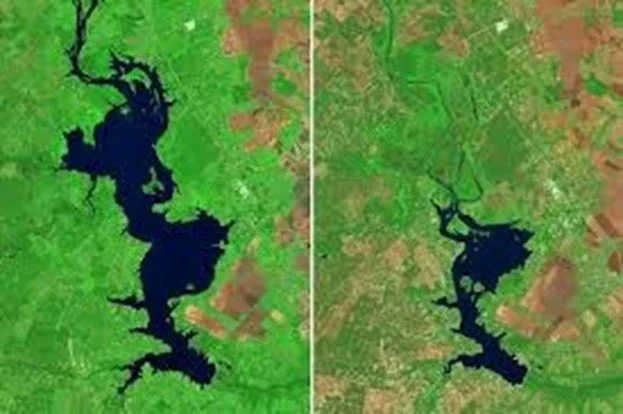
Lake Corpus Christi, Oct. 2021 vs Oct. 2025
Source: NASA
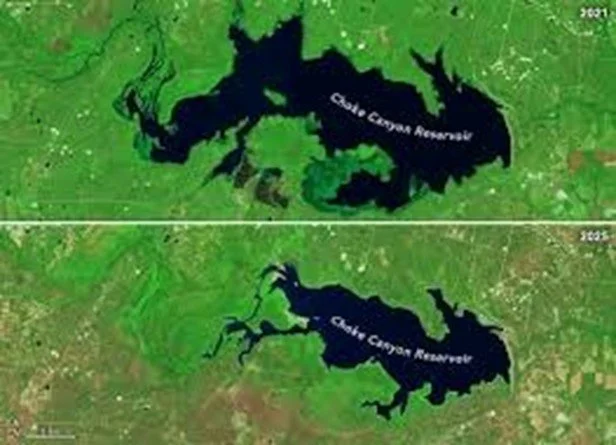
Choke Canyon Resevoir, Oct. 2021 vs Oct. 2025
Source: NASA
That’s not all, though – climate change also impacts energy use and accessibility. Hotter summers increase electricity demand for air conditioning, straining power grids and driving up electricity rates for consumers. Hotter temperatures cause metal power lines to sag, reducing their carrying capacity. Extreme weather events such as hurricanes, wildfires, and winter storms damage power plants, transmission lines, and fuel pipelines.
Finally, climate change increases health risks and can reduce well-being. Rising temperatures and heatwaves strain the cardiovascular system and can induce heat stroke. Higher concentrations of carbon dioxide act as plant fertilizer, and warmer temperatures cause longer growing seasons, allowing plants to produce more pollen, worsening allergies. Air quality reduces due to more frequent wildfires and smog accumulation due to hotter temperatures. Warmer climates allow disease-carrying insects to expand their range to places they were once previously rare, increasing risk for disease outbreaks. In addition to effects on physical health, climate change can affect mental health. Eco-anxiety, or the chronic fear, grief, or distress caused by environmental degradation and climate change, is something I struggle with and is also part of the reason why I wrote this article. Speaking from experience, it can be overwhelming and cause burnout – specifically, climate fatigue. This is emotional exhaustion and a sense of powerlessness when it comes to climate change. Like most types of burnout, climate fatigue can seep into other areas of your life, decreasing motivation and enjoyment of activities. If you are experiencing eco-anxiety or climate fatigue, try setting limits on climate news consumption, spending time outside, or channeling your nervous energy into controllable actions like reducing personal waste.
Final Thoughts
Whether viewed as a first-world problem because first-world countries contribute the most to climate change, or as a third-world problem because third-world countries experience the worst of climate change, climate change is still a global problem. Instead of vying for global dominance or antagonizing those who are different, it’s time we all made peace with each other to rise up against the single greatest challenge to humanity. With a little over three years left on the climate clock before climate change becomes unstoppably catastrophic, it’s more important than ever that people are aware of this existential threat.
There’s not much you could do that would solve climate change. But if we all started to care about climate change and started to take action, then that would be a different story. We could all start being more conscious about our consumption choices. We could all start joining climate action groups. We could start pitching in a bit of money to fund climate research. But we also have to keep the government and corporations accountable, too. Vote for climate-focused politicians, lobby for industry regulations, and protest when the people in charge are failing our planet. So, please, if you’re reading this, do something, anything, within your ability, within your power, within your resources, to help us face the climate crisis and ensure that the future generations inherit a better Earth.
If we don’t take care of our planet, how is our planet supposed to take care of us?
References
Cho, Renee. “How We Know Today’s Climate Change Is Not Natural.” State of the Planet, Columbia Climate School, 4 Apr. 2017, news.climate.columbia.edu/2017/04/04/how-we-know-climate-change-is-not-natural/.
“Climate Action against Disinformation | Extreme Weather, Extreme Content: How Big Tech Enables Climate Disinformation in a World on the Brink.” Caad.info, 2024, caad.info/analysis/reports/extreme-weather-extreme-content/.
Climate Central. “Sea Level Rise and Coastal Flood Risk Maps -- a Global Screening Tool by Climate Central.” Coastal.climatecentral.org, 2021, coastal.climatecentral.org/.
Climate Clock. “The Climate Clock.” ClimateClock.World, 2024, climateclock.world/.
“Climate TRACE Releases January 2026 Emissions Data.” Climate TRACE, 2026, climatetrace.org/news/climate-trace-releases-january-2026-emissions-data.
Cook, John, et al. America Misled | 1 How the Fossil Fuel Industry Deliberately Misled Americans about Climate Change AMERICA.
earthjustice. “How Climate Change Is Fueling Extreme Weather.” Earthjustice, 1 Oct. 2024, earthjustice.org/feature/how-climate-change-is-fueling-extreme-weather.
“Los Angeles Wildfires of 2025 | Britannica.” Encyclopedia Britannica, 2025, www.britannica.com/event/Los-Angeles-wildfires-of-2025.
Mirzabaev, Alisher, et al. “Severe Climate Change Risks to Food Security and Nutrition.” Climate Risk Management, vol. 39, no. 100473, 2023, p. 100473, www.sciencedirect.com/science/article/pii/S2212096322000808, https://doi.org/10.1016/j.crm.2022.100473.
NASA Earth Observatory. “Reservoirs Dwindle in South Texas.” NASA Science, 18 Nov. 2025, science.nasa.gov/earth/earth-observatory/reservoirs-dwindle-in-south-texas/.
National Centers For Environmental Information. “The Great Texas Freeze: February 11-20, 2021.” National Centers for Environmental Information (NCEI), 24 Feb. 2023, www.ncei.noaa.gov/news/great-texas-freeze-february-2021.
Stockemer, Daniel, and Jean-Nicolas Bordeleau. “Understanding Climate Change Conspiracy Beliefs: A Comparative Outlook.” MisInformation Review, 11 Dec. 2024, misinforeview.hks.harvard.edu/article/understanding-climate-change-conspiracy-beliefs-a-comparative-outlook/, https://doi.org/10.37016/mr-2020-162.
Taylor, Charlotte. “Defense, Denial, and Disinformation: Uncovering the Oil Industry’s Early Knowledge of Climate Change.” Common Home, 25 Oct. 2023, commonhome.georgetown.edu/topics/climateenergy/defense-denial-and-disinformation-uncovering-the-oil-industrys-early-knowledge-of-climate-change/.
United Nations. “Greenwashing – the Deceptive Tactics behind Environmental Claims.” United Nations, 2025, www.un.org/en/climatechange/science/climate-issues/greenwashing.
---. “Myth Busters.” United Nations, 2023, www.un.org/en/climatechange/science/mythbusters.
US EPA. “Climate Impacts on Energy | Climate Change Impacts | US EPA.” Epa.gov, 2009, 19january2017snapshot.epa.gov/climate-impacts/climate-impacts-energy_.html.
US EPA,OA. “Climate Impacts on Water Resources | Climate Change Impacts | US EPA.” Epa.gov, 2010, 19january2017snapshot.epa.gov/climate-impacts/climate-impacts-water-resources_.html.
“World Enters Era of “Global Water Bankruptcy.”” UN News, 20 Jan. 2026, news.un.org/en/story/2026/01/1166800.
World Health Organization. “Climate Change.” World Health Organization, 12 Oct. 2023, www.who.int/news-room/fact-sheets/detail/climate-change-and-health.
Zuckerman, Adam. “Driving Denial: How Toyota’s Unholy Alliance with Climate Deniers Threatens Climate Progress - Public Citizen.” Public Citizen, 14 Jan. 2025, www.citizen.org/article/driving-denial-how-toyotas-unholy-alliance-with-climate-deniers-threatens-climate-progress/.