The Affect of AI on the Creation of Art
by Dylan Joseph, 2025-2026 Co-President
October 29th, 2025

Introduction
Important note: I am not here to give a straight, binary answer to the complicated question of whether AI should be used in AI. Rather, I am here to articulate the complexities within our fast changing world, and provide arguments and reasonings from all sides. This article is mainly to explain how AI could and has affected the current creator economy and to foster thought about today’s world.
As AI models grow larger and larger, companies have to find different ways to get more training data. The more diverse, rich, human content these companies can find, the better these models can get in imitating us.
Companies need this data to feed them to huge Multimodal Models (models that can support several different types of inputs) to make art, music, text, and more.
Despite models getting closer to AGI and potentially having benefits, creators still don’t get benefited for contributing towards progress. Sometimes, companies will copyright strike music from artists despite it being in the public domain because the company has a recording of it.
In this post, I’ll explore the creation of AI artwork and its importance in the context of the world and artists.
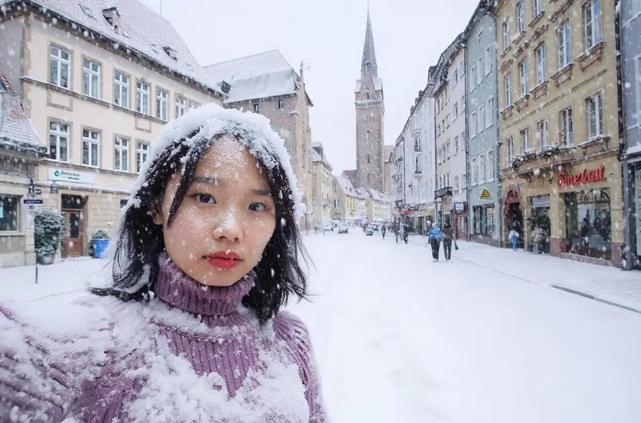
How does AI artwork and how do you detect it?
In essence, a model takes in a text input and creates a noisy image, and then tries decoding it. This is called Stable Diffusion.¹
To the right is an example:
These images are starting to get more and more realistic. You can still guess this is AI though. For starters, the signs don’t seem to be correct and they look like gibberish. Also, the image just feels too perfect. It is unrealistic to get a photo in the middle of the street with very few people, having snow barely hiding any facial features, and a clear view of a huge tower.
Another way to detect AI generation is to see if anything has “artifacts.” Artifacts are when a pixel or two seems off by a tiny bit. This is because when a model “denoises” or removes noise from an image, it doesn't properly do it. At the end of the day, it’s trying to find the average, not the exact output for every specific scenario.
If we can create a “perfect” image, what is the true purpose of these types of images?
Why do people make art?
Art is a creative expression– a way to show and evoke emotions, create joy, and show freedom³. Under this framework, what makes AI images “art”? All they do is try to explain some idea of a human prompter, but they truly can’t capture the explanation: all they do is give weighted averages of what’s possible. Sure, AI art might be good for prototyping and seeing possibilities, but it can’t capture a very clear, one idea. Again, all it’s doing is calculating an estimation of what you might want, not an exact idea.
As one Harvard lecturer (Yosvany Terry) said, “‘the ability to react in the moment, is something that artificial intelligence can’t reproduce.’”⁴
Despite this, why do people defend AI “art”? It’s just like photography and painting: just because you can photograph something doesn’t mean painting it is unnecessary.⁵ In the same way, having AI “art” doesn’t mean it will replace real artists, rather, it could be used as a supplement, creating prototypes to understand and come to a consensus with a buyer quicker, saving both time and money.
This also does bring another interesting point: why do we care if something has a “soul” in the image? Philosophically, everything has some meaning, some purpose, whether or not we like to admit it.
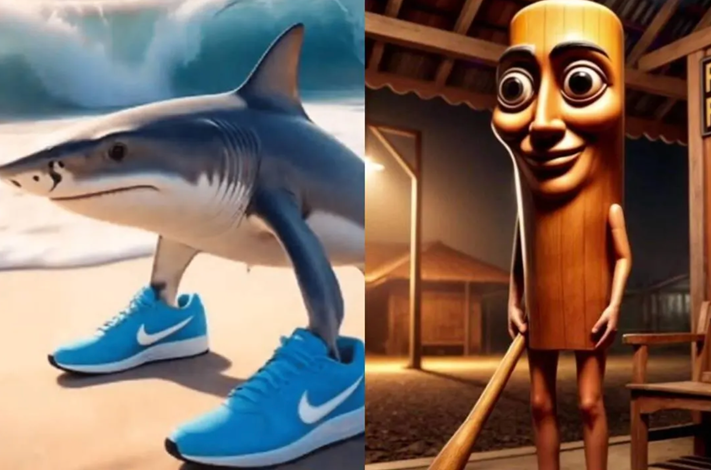
Whether we like to admit it or not, even a prompt-engineered AI image can have some expressive purpose. Take the recent Italian Brainrot character “Tralalero Tralala” and “Tung Tung Tung Sahur,” (Image of Tralalero Tralala on left and Tun Tung Tung Sahur on right⁶)
This is a generated image of a shark with shoes. These images are nonsensical prompting created for amusement. Some see value in it, in fact, it has even been integrated into videogames.⁷
Even if we do find value within these works, we’re still stuck with the same question: is it just for musicians and artists to have their work reproduced and stolen from them without permission for the enjoyment of some?
Could musicians and artists copyright claim AI “art”?
Matter of fact, authors want to fight against companies that have stolen their work.⁸ Unfortunately, it’s probably not possible to copyright claim art. It’s extremely difficult to claim AI has stolen your style. Although there are some exceptions (like the “Studio Ghibli" style), the lines are super blurry and unclear. In fact, there is a lawsuit against the company Suno currently going on.⁹
And, do musicians really need to copyright strike AI? Yes, because they still feed on the musician’s success. The more diverse, rich, human content these companies can find, the better these models can get in imitating us.
In the case of music, startups have been using unlicensed works to train their models. However, companies have decided to finally bargain with startups: allow them to license the work instead of suing them.¹⁰
I still want to leave you with a question: how should the creator economy change, and how should we think of art moving forward?
Still, it isn’t the musicians’ choice. Does this mean we can still make AI music even if we get musicians’ consent?
——————————————————
¹ Mishra, Onkar. 2023. “Stable Diffusion Explained.” Medium. June 14, 2023.
https://medium.com/@onkarmishra/stable-diffusion-explained-1f101284484d.
²“Black Forest Labs - Frontier AI Lab.” 2025. Bfl.ai. 2025. https://bfl.ai/models/flux-kontext.
³Smith, Jeremy Adam, and Jason Marsh. 2008. “Why We Make Art.” Greater Good. December 1, 2008.
https://greatergood.berkeley.edu/article/item/why_we_make_art.
⁴Mineo, Liz. 2023. “If It Wasn’t Created by a Human Artist, Is It Still Art?” The Harvard Gazette. Harvard
University. August 15, 2023. https://news.harvard.edu/gazette/story/2023/08/is-art-generated-by-artificial-intelligence-real-art/.
⁵ Boehman, Craig. 2023. “In Defense of AI Art.” Craig Boehman. Craig Boehman. June 13, 2023.
https://craigboehman.com/blog/in-defense-of-ai-art.
⁶ Placido, Dani Di. 2025. “Roblox’s ‘Italian Brainrot’ Trend, Explained.” Forbes, September 19, 2025.
https://www.forbes.com/sites/danidiplacido/2025/09/19/robloxs-italian-brainrot-trend-explained/.
⁷Placido, Dani Di. 2025. “Roblox’s ‘Italian Brainrot’ Trend, Explained.” Forbes, September 19, 2025.
https://www.forbes.com/sites/danidiplacido/2025/09/19/robloxs-italian-brainrot-trend-explained/.
⁸ Rogers, Andrew. 2025. “Meta AI Book Scraping: ‘We Need to Speak Up’, Say Authors.” BBC, April 3, 2025.
https://www.bbc.com/news/articles/c70w24j7jk1o.
⁹Weatherbed, Jess. 2025. “Record Labels Claim AI Generator Suno Illegally Ripped Their Songs from YouTube.” The Verge. September 22, 2025.
https://www.theverge.com/news/782448/riaa-suno-ai-lawsuit-update-stream-ripping-youtube.
¹⁰ Dalugdug, Mandy. 2025. “Labels in Licensing Talks with AI Music Generators Suno and Udio (Report).” Music Business Worldwide. June 2, 2025.
https://www.musicbusinessworldwide.com/universal-warner-and-sony-in-talks-to-license-ai-music-generators-suno-and-udio-report/.
